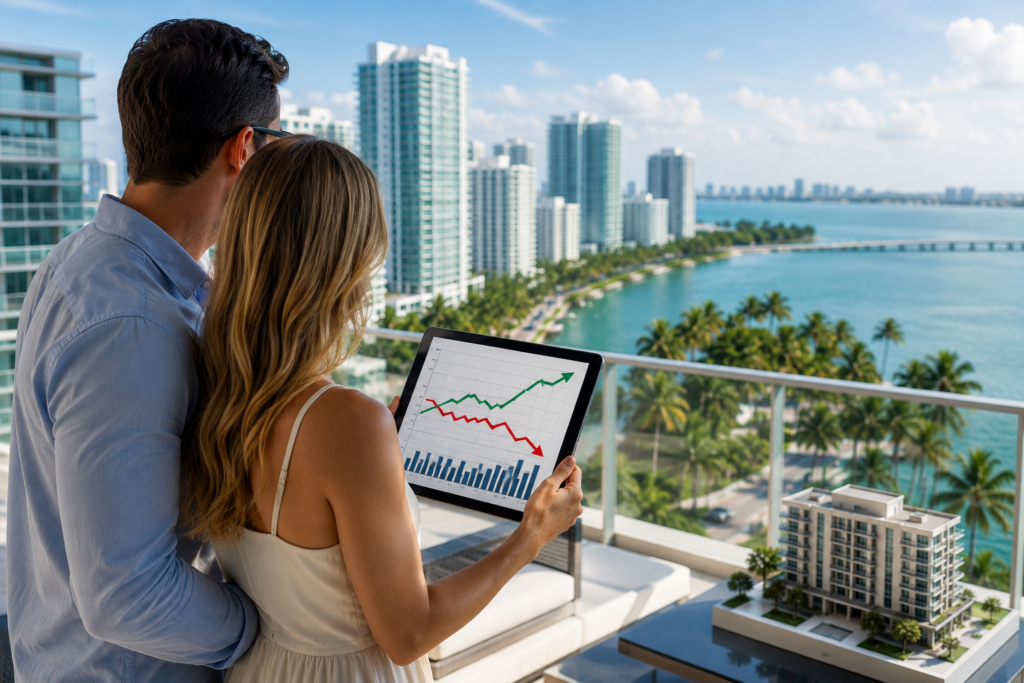
Will South Florida home prices go up or down? The most likely answer is both, depending on the property type, location, and price range. Single-family homes in strong areas may stay firm or rise slowly because supply is tight. Some condos may see softer pricing because buyers have more choices and higher ownership costs. In Miami, Brickell, Miami Beach, Sunny Isles, Aventura, Downtown Miami, Edgewater, and Coral Gables, the story is not one big crash or one big boom. It is a more selective market, where the best homes still get attention and overpriced homes sit longer.
The Big Picture: A More Balanced Market
South Florida is not moving in one simple direction. That is what makes today’s market so interesting.
For the last few years, buyers were asking, “Can I even find a good property?” Now they are asking, “Is this property priced right?” That shift matters.
Recent Miami-Dade data shows home sales are still active, but buyers are taking more time. In April 2026, Miami-Dade total home sales rose 5.6% year over year, while single-family transactions rose 8.6% and condo sales rose 2.8%. At the same time, Miami-Dade single-family median prices slipped 1.47% year over year, while condo median prices rose 1.12%.
So, are South Florida home prices rising or falling? The better answer is this: prices are separating.
A well-located single-family home near Coral Gables, Miami Beach, or parts of Aventura may still be hard to replace. A dated condo with high monthly costs may need a sharper price to attract serious buyers. That is not a weak market. That is a smarter one.
Why South Florida Home Prices Are Not Dropping Everywhere
There are still strong forces supporting South Florida home prices.
Miami continues to attract people from other states and other countries. Buyers are drawn to the lifestyle, tax climate, beaches, schools, restaurants, boating, nightlife, and business growth. The appeal is not just sunshine. It is freedom, access, and status with a palm-tree backdrop.
There is also a limited supply of single-family homes in many prime neighborhoods. You cannot easily create more waterfront land in Miami Beach. You cannot duplicate the feel of Coral Gables overnight. You cannot build endless new single-family homes in established areas close to Brickell, Downtown Miami, and the airport.
That supply issue supports pricing.
Miami-Dade single-family inventory dropped 14.55% year over year in April 2026, and the market had 5.4 months of supply, which points to a seller’s market. Existing condo inventory had 12.9 months of supply, which points to a buyer’s market.
That split is the heart of the market right now.
Why Some Prices Could Move Lower
Some South Florida home prices may move lower, especially when a property is not positioned well.
Higher mortgage rates have made monthly payments more expensive. Insurance costs, condo association fees, special assessments, and maintenance rules are also part of the decision now. Buyers are not just looking at the purchase price. They are looking at the full monthly cost.
This is especially important for condos.
In some buildings, buyers are asking tougher questions:
- How healthy are the reserves?
- Are there upcoming assessments?
- Has the building completed major repairs?
- Is the monthly maintenance reasonable?
- Can the building qualify for common financing options?
- Are similar units sitting on the market?
That does not mean Miami condos are a bad choice. Far from it. The right building in Brickell, Edgewater, Miami Beach, Sunny Isles, or Aventura can still be an excellent lifestyle play or long-term hold. But buyers are being more careful, and that can create price adjustments in buildings with higher friction.
In Broward, April 2026 data showed single-family median prices down 1.59% year over year and condo median prices down 7.86% year over year, even as total sales rose 4.7%. That tells us demand exists, but pricing must meet the moment.
Will South Florida Home Prices Go Up or Down in 2026?
South Florida home prices are more likely to move sideways or rise modestly in strong segments, while some weaker condo segments may soften. Prime single-family homes, newer luxury condos, and well-managed buildings should hold up better. Older or overpriced properties may need price cuts to sell.
That means the market is not crashing. It is becoming more honest.
For buyers, that can be good news. More balance means more room to compare options, ask better questions, and negotiate with confidence. For sellers, it means the old “name any price and wait” strategy is not as safe as it once was.
Miami Condos Are Their Own Market
Miami condos deserve their own conversation.
A Brickell condo is not the same as a waterfront condo in Sunny Isles. A boutique building in Coral Gables is not the same as a large older tower in Miami Beach. A new luxury residence in Edgewater is not the same as a 1970s building with rising costs.
This is why local guidance matters.
Some buyers are focused on Miami luxury rentals before they buy. Others are watching Miami pre construction condos because they want newer amenities, modern design, and fewer short-term repair concerns. Investors are also studying Miami investment property options that can serve both lifestyle and long-term wealth goals.
In Miami-Dade, condo median prices have shown long-term strength. MIAMI REALTORS reported that Miami condo prices have increased 295.4% since 2011, from $113,800 to $450,000. That history is strong, but it does not mean every condo will rise at the same pace from here.
The building matters. The view matters. The reserves matter. The floor plan matters. And yes, the vibe matters too. Miami buyers care about numbers, but they also care about how a property feels when the elevator doors open.
What This Means for Buyers
If you are buying property in Miami or greater South Florida, this market gives you more room to be strategic.
You may not need to chase every listing. You can compare days on market, recent sales, building financials, and future supply. You can also decide whether you want a primary home, a second home, a Miami investment property, or a luxury rental first while you learn the neighborhoods.
Smart buyers should focus on:
- Location quality
- Building condition
- Monthly ownership costs
- Resale demand
- Rental rules
- Future development nearby
- Walkability and lifestyle
- Long-term scarcity
In Brickell, the draw is energy, restaurants, offices, and skyline views. In Miami Beach, it is lifestyle, ocean access, and global name recognition. In Edgewater, buyers often want bay views and proximity to the Design District, Wynwood, and Downtown Miami. In Coral Gables, many buyers want charm, space, and a quieter luxury feel.
The right choice depends on your life, not just a chart.
What This Means for Sellers
Sellers still have power, but only when the price and presentation are right.
South Florida buyers are sharper now. They watch price reductions. They compare buildings. They notice stale listings. They ask about insurance, reserves, and repairs. If a home looks tired, is priced above the market, or has unclear costs, buyers may pass.
A strong seller strategy should include:
- Accurate pricing from day one
- Clean presentation
- Strong photography and video
- Clear cost details
- Smart timing
- A plan for buyer questions
- Local market context
Luxury buyers still want quality. They also want confidence. That is where preparation wins.
Where Prices May Be Strongest
The strongest areas will likely be places with limited supply, strong lifestyle demand, and clean property fundamentals.
That includes select single-family neighborhoods, waterfront homes, renovated properties, newer condos, and buildings with strong management. Areas like Miami Beach, Coral Gables, Brickell, Edgewater, Sunny Isles, and Aventura may all have winning properties, but not every listing is a winner.
South Florida is too diverse for blanket answers. A premium unit with direct bay views may behave very differently from a similar-size unit with no view and high monthly fees. Two homes can be five blocks apart and tell two very different price stories.
That is why the question is not just “Will prices go up or down?” The better question is, “Which property has the best chance to hold value and attract demand?”
Should You Wait to Buy in South Florida?
Waiting can help if you are targeting a property type with rising inventory and flexible sellers. But waiting can also cost you if you want a scarce home in a prime location. The best move is to study the exact neighborhood, property type, and building before deciding.
There is no perfect market. There is only the right plan.
If rates improve, more buyers may jump back in. If inventory tightens further, the best homes could become more competitive again. On the other hand, if a condo building has high costs or weak buyer demand, patience may help.
The Bottom Line
South Florida home prices are not simply going up or down. They are becoming more selective. Prime single-family homes and strong luxury properties may remain steady or rise modestly. Some condos and overpriced listings may soften until pricing feels right.
For buyers, this is a chance to be careful, calm, and strategic. For sellers, it is a reminder that smart pricing and polished marketing matter more than ever.
Christa Reday and I watch these neighborhood shifts closely, from Brickell condos to Miami pre construction condos, Miami luxury rentals, and long-term investment options. Reach out for thoughtful guidance, property options, or advice before you make your next move.
My name is Jean-Paul Rivera of Vida Luxury Group, where we bring luxury to life.